
Here’s what every business owner needs to know, and why having an experienced partner in your corner matters more than ever.
The digital marketing landscape has never been more complicated — or more consequential. In 2026, the question businesses keep asking isn’t simply “should we post on social media?” It’s a more nuanced challenge: “How do we actually reach the right people, and how do we know if it’s working?”
The answer almost always comes back to the same foundational debate: organic versus paid reach. Understanding the difference between the two — and knowing how to use both strategically — can be the deciding factor between a brand that grows and one that stalls. Here’s what every business owner needs to know, and why having an experienced partner in your corner matters more than ever.
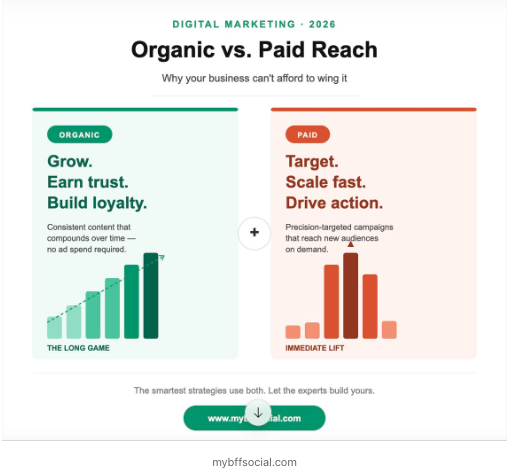
What Is Organic Reach? Organic social media refers to the unpaid content that brands publish on social platforms — posts, stories, videos, and community engagement that reach audiences without advertising dollars behind them. When done well, organic content reaches your existing followers, people who search for your content, and users who discover you through shares or platform algorithms.
The core strength of organic is trust. As marketing experts have noted, organic is where your voice, values, and personality come through — it’s where potential customers form a real impression of your brand rather than simply seeing an ad. That kind of authentic connection builds loyalty that paid media alone cannot manufacture. Organic content can also keep generating engagement and compounding value long after it’s first published, making it one of the stickiest investments a brand can make.
But organic reach has real limitations, particularly in 2026. Social platforms continue to prioritize paid content in their algorithms, meaning even your best organic posts may only reach a fraction of your own followers. Building meaningful organic momentum requires consistency, creativity, and time — none of which most business owners have in unlimited supply.
What Is Paid Reach? Paid social media — sponsored posts, targeted ad campaigns, boosted content, influencer partnerships — lets brands pay to put their message in front of specific audiences. Unlike organic content, which relies on algorithms and follower behavior, paid social gives you direct control over who sees your content, how often, and when.
The advantages are substantial. Paid campaigns can scale quickly, reach entirely new audiences outside your existing follower base, and be optimized in real time based on performance data. Social media ad spending continues to grow year over year as brands recognize that paid reach is one of the fastest, most measurable ways to drive action — whether that’s website clicks, lead generation, or direct sales.
The trade-off, of course, is cost and complexity. Running effective paid campaigns requires strategic targeting, compelling creative, ongoing budget management, and a clear understanding of how to interpret performance data. Done poorly, paid social is an expensive way to reach the wrong people with the wrong message at the wrong time.
Why Is the Answer Always Both? The debate between organic and paid reach is largely a false choice. The brands that consistently outperform their competitors aren’t picking one or the other — they’re using both in a deliberate, coordinated way.
Think of organic and paid as two sides of the same coin. Organic content builds the foundation: it establishes your brand voice, nurtures your existing community, and creates content that earns trust over time. Paid amplification then extends the reach of your best content, puts your brand in front of new audiences, and accelerates results when you need to move quickly. When a piece of organic content is performing well, adding a paid boost behind it isn’t starting from scratch — it’s doubling down on something that’s already working.
The hybrid approach also gives you something neither channel can deliver alone: a complete picture. Organic metrics tell you what resonates with your audience. Paid data tells you how effectively you can scale that resonance. Together, they reveal a far more accurate map of what’s actually driving growth.
The Expertise Gap Is Widening: Here’s the part that often catches business owners off guard: the gap between businesses that manage their own marketing and those that rely on experienced professionals has grown dramatically. In 2026, the tools are more powerful, the targeting options more sophisticated, and the platforms more competitive than at any point before.
At MyBFF Social, we’ve seen this play out repeatedly. Businesses that attempt to self-manage their digital marketing often fall into one of two traps: they either invest all their energy in organic content without ever putting paid fuel behind it, or they launch paid campaigns without the foundational brand presence and content strategy that make those ads convert. Both paths waste time, money, and opportunity.
Effective digital marketing strategy in 2026 requires a working knowledge of platform algorithms, audience targeting, content creation, paid media buying, analytics interpretation, and increasingly, AI-powered tools that are reshaping how content is discovered and consumed. That’s not a part-time job — it’s a discipline that demands ongoing attention and expertise.
As we’ve written about on our own blog, standing out online in 2026 has less to do with volume and more to do with strategy. It’s not about posting more. It’s not about chasing every trend. It’s about showing up with a clear point of view, in the right channels, with the right balance of organic consistency and paid amplification.
What a Smart Hybrid Strategy Looks Like: A well-executed hybrid approach typically looks something like this:
Organic efforts lay the groundwork — establishing your brand voice through regular content that educates, entertains, or connects with your audience. This isn’t random posting; it’s an intentional content calendar aligned with your business goals, your audience’s interests, and the realities of each platform’s algorithm.
Paid campaigns then extend that reach strategically. The best-performing organic posts become candidates for boosting. Targeted ad campaigns reach new audiences who match the profile of your best customers. Retargeting ads re-engage visitors who have already shown interest in your brand or product.
Throughout all of it, data drives the decisions. Which content formats are earning the most engagement? Which audience segments are converting most efficiently? Which platforms are delivering the best return on your paid investment? These aren’t questions with one-time answers — they require continuous monitoring and adjustment.
That’s exactly why expertise matters. Managing a hybrid organic-and-paid strategy across multiple platforms, while also running a business, is genuinely difficult. The businesses that get it right aren’t doing it alone.
Ready to Build a Strategy That Actually Works? Whether you’re just beginning to think seriously about your digital marketing or you’re looking to take a fragmented effort and turn it into something cohesive and effective, the team at MyBFF Social can help.
We work with businesses across industries to develop integrated marketing strategies that combine organic content, paid media, social management, CRM, PR, and more — tailored to your specific goals and budget. We know the platforms, we know the data, and we know how to translate marketing activity into real business results.
About MyBFF Social: MyBFF Social is a full-service marketing agency specializing in social media, marketing, and advertising for home services and lifestyle brands, franchisors, and private equity portfolios. The firm combines strategic rigor with boutique-level service, delivering multilingual marketing solutions focused on measurable growth and continuous improvement.
Drive down overhead costs and move your business forward with MyBFF Social today. Check out our Digital Marketing Mastery Program today. Contact Matt Gentile, CEO, today at 412-477-3349 or email matt@mybffsocial.com or schedule a consultation via: https://calendly.com/mybffsocial.
Sources: